
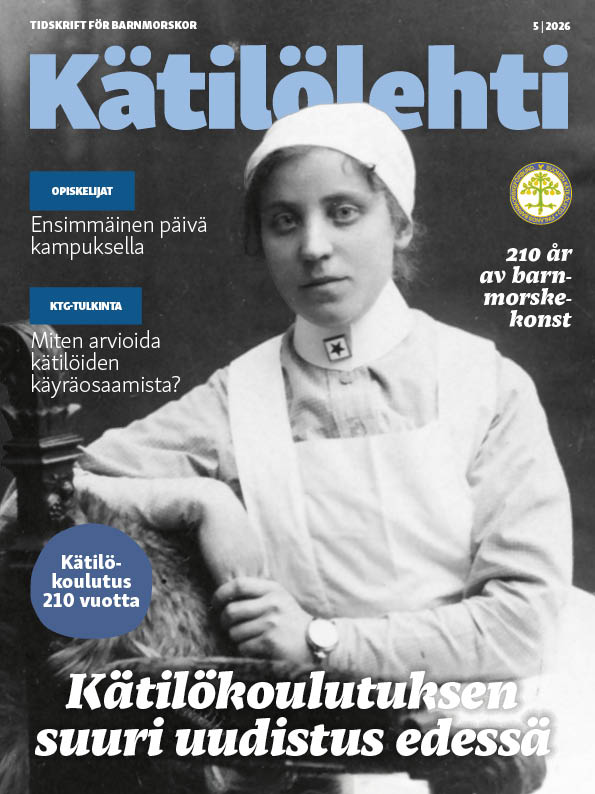
3 Pääkirjoitus
4 Ajankohtaista
6 Kätilö-opiskelija osoittaa lääkehoito- osaamistaan Lääkehoitopassilla
9 Päättäjä piinapenkissä: Jessi Jokelainen
10 Kätilökoulutuksen 210-vuotinen taival – Iso uudistus nurkan takana
16 Kätilöntaimet kampuksella
19 Kätilötieteellinen kolumni
20 Monikulttuurisuus vaatii kätilökoulutustakin kehittymään
23 In memoriam – Merja Kumpula
24 Ledare
25 210 år av kunskap, omsorg och förändring
28 Barnmorskeutbildningens 210-åriga resa – och en betydande reform runt hörnet
30 Laadukas opiskelijaohjaus rakentaa tulevaisuuden kätilöitä
32 Kätilökoulutus maailmalla
33 WHO:n toimintaohjelman tavoitteena on vahvistaa kätilökoulutusta
34 Kätilökoulutuksen erityispiirteitä ja ongelmia maailman eri kolkissa
35 Kätilöopiskelijan ääni
36 Kätilöhoidon jatkuvuus – paluu kätilötyön ytimeen
38 Kohti parempaa KTG-tulkintaa
41 Kätilön kirjahylly
42 Raskausdiabetes – missä omahoito kohtaa haasteita?
44 Käyräkulma: Lääkkeiden vaikutus kardiotokografiin
47 Kätilölehden kulisseissa
48 Kätilöstä on moneksi: Hanna Koivikko
50 Uutisia
MARI BERGLUND, OONA KÄHKÖNEN, MINNA MANNINEN, SANNA-MARI MANNINEN, MARIKA METTÄLÄ, PERNILLA STENBÄCK, ELINA TIAINEN & TERESE ÖSTERBERG: Kätilökoulutuksen 210-vuotinen taival – Iso uudistus nurkan takana
Laki ammattikorkeakoululain muuttamisesta 467/2026. Suomen säädöskokoelma. https://www.finlex.fi/fi/lainsaadanto/saadoskokoelma/2026/467
Opetus- ja kulttuuriministeriö, sosiaali- ja terveysministeriö. (2023). Loppuraportti: Sosiaali- ja terveysalan korkeakoulutuksen kehittäminen -hanke (Valtioneuvoston julkaisuja 2023:15). Valtioneuvosto. http://urn.fi/URN:ISBN:978-952-383-958-8
Raussi-Lehto, E., & Ryttyläinen-Korhonen, K. (toim.), (2016). Koulutettu kätilö kanssasi 200 vuotta.
Tallberg, M., Hyttinen, H., & Korteniemi, A. (1996). 100 vuotta työtä terveyden hyväksi. Oulun terveydenhuolto-oppilaitos.
RIIKKA HELAKISA: Kätilöntaimet kampuksella
Haku ja valinta. Opetushallinnon tilastopalvelu Vipunen. Haettu 4.10.2026. https://vipunen.fi/fi-fi/_layouts/15/WopiFrame2.aspx?sourcedoc=%7B8a1b2e44-a1ac-49cc-8532-57c0511aada5%7D
Kätilö (AMK), päiväopiskelu. Metropolia Ammattikorkeakoulu. Haettu 20.9.2026. https://www.metropolia.fi/fi/opiskelu-metropoliassa/amk-tutkinnot/katilo
Kätilö (AMK), täydentävät opinnot sairaanhoitajille. Haettu 20.9.2026. https://www.metropolia.fi/fi/opiskelu-metropoliassa/amk-tutkinnot/katilo
Myllypuron kampuksen toinen vaihe luovutettiin Metropolialle – Kampuksen loppuosa avataan tammikuussa. ePressi 2019. Haettu 16.9.2026.
https://www.epressi.com/tiedotteet/koulutus/myllypuron-kampuksen-toinen-vaihe-luovutettiin-metropolialle-kampuksen-loppuosa-avataan-tammikuussa.html
Myllypuron kampus. Metropolia Ammattikorkeakoulu. Haettu 16.9.2026.
https://www.metropolia.fi/fi/metropoliasta/kampukset/myllypuro
Vertaistutorin käsikirja. Metropolia Ammattikorkeakoulun opiskelijakunta – METKA 2013.
https://metkaweb.fi/wp-content/uploads/2015/08/Tutorin-kasikirja-kevat-2014.pdf
Vuosikatsaus 2025. Metropolia Ammattikorkeakoulu. Haettu 1.10.2026.
https://www.metropolia.fi/fi/metropoliasta/ajankohtaista/vuosikatsaukset/2025
Sekä Janni Kosken ja Sanna-Mari Mannisen sähköpostivastaukset.
SANNA LÖNNFORS: Kätilökoulutus maailmalla
Framework for Action: Strengthening Quality Midwifery Education for Universal Health Coverage 2030, https://www.who.int/publications/i/item/9789241515849, luettu 23.6.2026
Moran L, Capper T, Gupta M, Meedya S, Mendez S. Financial hardship and Australian midwifery students: A scoping review and thematic analysis. Women Birth 2024 Sep;37(5):101640. doi: 10.1016/j.wombi.2024.101640.
McKellar L, Graham K, Sheehan A, Fleet J-A, Sidebotham M, Sweet L. Examining the transformation of midwifery education in Australia to inform future directions: An integrative review. Women Birth 2023 Mar;36(2):155-166. doi: 10.1016/j.wombi.2022.11.010.
Asfaw Derso Y, Aligaz Adisu M, Atamenta Kitaw T, Hurisa Dadi H, Bekele Beriso H, Abebe W, Engdaw Habtie T, Tigabu D, Abiye Munie M, Dessie Gessesse A, Yetwale Hiwot A. Clinical Practice Competency and Associated Factors Among Midwifery and Nursing Students in Ethiopia: A Systematic Review and Meta-Analysis. Nurs Open 2026 Feb;13(2):e70413. doi: 10.1002/nop2.70413.
Bogren M, Alesö A, Teklemariam M, Sjöblom H, Hammarbäck L, Erlandsson K. Facilitators of and barriers to providing high-quality midwifery education in South-East Asia—An integrative review. Women Birth 2022 May;35(3):e199-e210. doi: 10.1016/j.wombi.2021.06.006.
Rodriguez Navarro D, Oyarzo Torres SG. Midwifery education in Latin America: Integrating clinical reasoning for safer and more autonomous practice. Midwifery 2025 Oct:149:104578. doi: 10.1016/j.midw.2025.104578.
Plappert CF, Bauer NH, Dietze-Schwonberg K, Grieshop M, Kluge-Bischoff A, Zyriax B-C, Striebich S. Academic education of midwives in Germany (part 1): Requirements for bachelor of science programmes in midwifery education. Position paper of the Midwifery Science Committee (AHW) in the DACH Association for Medical Education (GMA). GMS J Med Educ 2024 Jun 17;41(3):Doc33. doi: 10.3205/zma001688
Lindbergh LD, Blumenfeld J, Tierney K, Alspaugh A. Midwifery Students’ Experiences Obtaining Clinical Placements and Associations With Training Quality: “I Had to Figure It Out on My Own”. J Midwifery Womens Health 2026 May-Jun;71(3):395-403. doi: 10.1111/jmwh.70097.
Vainio-Korhonen, K. (2012). Ujostelemattomat. Kätilöiden, synnytysten ja arjen historiaa. WSOY.
MAIJA MÄNNISTÖ: Kohti parempaa KTG-tulkintaa
Ayres-de-Campos, D., Arulkumaran, S., FIGO Intrapartum Fetal Monitoring Expert Consensus Panel, 2015. FIGO consensus guidelines on intrapartum fetal monitoring: physiology of fetal oxygenation and the main goals of intrapartum fetal monitoring. Intl. J. Gynecol. Obs. 131 (1), 5–8.
Byford, S., Weaver, E., Anstey, C., 2014. Has the incidence of hypoxic ischaemic encephalopathy in Queensland been reduced with improved education in fetal surveillance monitoring? Aust. N.Z. J. Obst. Gynaeco. 54 (4), 348–353.
Chandraharan, E., 2017. Applying fetal physiology to interpret CTG traces. Predicting the next change. In: Chandraharan, E. (Ed.), Handbook of CTG Interpretation: From Patterns to Physiology. Cambridge University Press, pp. 32–40.
Chandraharan, E., Evans, S.-A., Krueger, D., Pereira, S., Skivens, S., Zaima, A., 2018. Physiological CTG interpretation. Intrapartum. Fetal Monit. Guidel. Available from: Directive 2005 /36/EC of the European Parliament and of the Council on the recognition of professional qualifications.
Evers, A.C.C., Brouwers, H.A.A., Nikkels, P.G.J., Boon, J., Van Egmond-Linden, A., Groenendaal, F., Hart, C., Hillegerberg, J., Snuif, Y.S., Sterken-Hooisma, S., Steins Bisschop, C.N., Westerhuis, M.E.M.H., Bruinse, H.W., Kwee, A., 2013. Substandard care in delivery-related asphyxia among term infants: prospective cohort study. Acta Obs. Gynecol. Scand. 92 (1), 85–93.
Finnish Institute of Health and Welfare, 2024. Perinatal Statistics – Parturients, Delivers and Newborns 2023. THL – Statistical report 50/2024. Available from. Hollesen R von, B., Johansen, R.L.R., Rørbye, C., Munk, L., Barker, P., Kjaerbye-Thygesen, A., 2018. Successfully reducing newborn asphyxia in the labour unit in a large academic medical centre: a quality improvement project using statistical process control. BMJ Qual. Saf. 27 (8), 633–642.
Holzmann M., Jonsson M., Albertsson S. 2018. CTG- & fosterövervakning. Available from: https://ctgutbildning.se.
Jernman, R., Tarvonen, M., Haapsamo, M., Linna, E., Stenman, T., Radi, H., 2022. Duodecim Verkkokurssit. KTG.
Jonsson, M., Ågren, J., Nord´ en-Lindeberg, S., Ohlin, A., Hanson, U., 2014. Neonatal encephalopathy and the association to asphyxia in labor. Am. J. Obs. Gynecol. 211 (6). 667.e1-667.e8.
Lojander, J., Welling, M., Axelin, A., Härkänen, M., Kopra, J., Lamminpää, R., 2024. Obstetric claims in Finland 2012-2022 – A nationwide patient insurance registry study. Acta Obs. Gynecol. Scand. 103, 1377–1385.
Lynn, M., 1986. Determination and quantification of content validity. Nurs. Res. 35 (6), 382–385. Nov/Dec.
Maduna, N.E., 2016. Midwives’ Perceptions in Kwazulu-Natal public Hospitals Regarding Their Level of Competence Related to Cardiotocography. Nelson Mandela Metropolitan University [dissertation].
Miller, L.A., 2017. Education, competency, certification, credentialing: what’s the difference? J. Perinat. Neonatal Nurs. 31 (2), 101–103.
Männistö, M., Lojander, J., Welling, M., Axelin, A., Härkänen, M., & Lamminpää, R. (2025a). Asphyxia due to substandard obstetric care in Finland: An 11-year patient insurance registry study of compensated patient claims. European Journal of Obstetrics & Gynecology and Reproductive Biology, 314, 114721.
National Certification Corporation (NCC), 2024. 2024 Candidate Guide Electronic fetal Monitoring C-EFM®. Available from: https://www.nccwebsite.org/content/documents/cms/efm-candidate_guide.pdf.
National Institute for Health and Care Excellence (NICE), 2022. Fetal Monitoring in Labour. NICE guideline [NG229]. NICE, London. Available from: https://www.nice.org.uk/guidance/ng229/resources/fetal-monitoring-in-labour-pdf-66143844065221 .
Polit, D.F., Beck, C.T., 2006. The content validity index: are you sure you know what’s being reported? Critique and recommendations. Res. Nurs. Health 29 (5), 489–497.
Polit, D.F., Beck, C.T., Owen, S.V., 2007. Is the CVI an acceptable indicator of content validity? Appraisal and recommendations. Res. Nurs. Health 30 (4), 459–467.
Royal College of Obstetricians and Gynaecologists, 2021. Each Baby Counts: 2020 Progress Report. RCOG, London.
Sadler, L.C., Farquhar, C.M., Masson, V.L., Battin, M.R., 2016. Contributory factors and potentially avoidable neonatal encephalopathy associated with perinatal asphyxia. Am. J. Obs. Gynecol. 214 (6), 747.e1-
747.e8.
Said, A.R., Ali, H.A., 2020. Effect of supportive nursing instructions for maternity nurses regarding electronic fetal monitoring. Int. J. Nurs. Sci. 10 (1), 1–11.
Tekay, A., Nuutila, M., Heinonen, S., 2017. Voidaanko synnytysturvallisuutta parantaa? Duodecim 133 (3), 235–236, 2017.
Thellesen, L., Bergholt, T., Hedegaard, M., Colov, N.P., Hoegh, S., Sorensen, J.L., 2015. Curriculum development for a national cardiotocography education program: a Delphi survey to obtain consensus on learning objectives. Acta Obs. Gynecol. Scand. 94 (8), 869–877.
Thellesen, L., Sorensen, J.L., Hedegaard, M., Rosthoej, S., Colov, N.P., Andersen, K.S., Bergholt, T., 2017a. Cardiotocography interpretation skills and the association with size of maternity unit, years of obstetric work experience and healthcare professional background: a national cross-sectional study. Acta Obs. Gynecol. Scand. 96 (9), 1075–1083.
Thellesen, L., Hedegaard, M., Bergholt, T., Colov, N.P., Christensen, K.B., Andersen, K.S., Sorensen, J.L., 2017b. Development of a written assessment for a national interprofessional cardiotocography education program. BMC Med. Educ. 17 (1), 88.
The Royal Australian and New Zealand College of Obstetricians and Gynaecologists (RANZOG), 2023. Online Fetal Surveillance Education Program. OFSEP.
World Health Organization (WHO), 2014. WHO recommendations: Intrapartum Care For a Positive Childbirth Experience. World Health Organization, Geneva
Zhu, L.A., Blanc, J., Heckenroth, H., Peyronel, C., Graesslin, B., Marcot, M., Tardieu, S., Bretelle, F., 2021. Fetal physiology cardiotocography training, a regional evaluation. J. Gynecol. Obstet. Hum. Reprod. 50 (6), 102039., 2021 Jun.
Zoanetti, N., Beaves, M., Griffin, P., Wallace, E.M., 2013. Fixed or mixed: a comparison of three, four and mixed-option multiple-choice tests in a fetal surveillance education program. BMC Med. Educ. 13 (1), 35.
JONNA MBAH: 210 år av kunskap, omsorg och förändring Barnmorskans väg genom Finlands historia
Helsingin kaupunki: Lapsenpäästäjistä kätilöihin. https://historia.hel.fi/fi/ilmiot/helsingin-asukkaat/lapsenpaastajista-katiloihin
Naisjärjestöjen Keskusliitto: Kätilö on vanhin koulutetun naisen ammatti – Ammattikätilöyden kehittyminen 1700-luvulta tähän päivään. https://naisjarjestot.fi/katilo-on-vanhin-koulutetun-naisen-ammatti-ammattikatiloyden-kehittyminen-1700-luvulta-tahan-paivaan/
Metropolia AMK – KätIlökouluttaja-blogi: Kätilökoulutuksesta – Näin syntyy kätilö. https://blogit.metropolia.fi/katilokouluttaja/2019/01/31/katilokoulutuksesta-nain-syntyy-katilo/
ANNIKA NIEMI & ANITA WIKBERG: Monikulttuurisuus vaatii kätilökoulutustakin kehittymään
Niemi, A., & Wikberg, A. (2025). *Integrating person-centred care and intercultural communication in midwifery education: A curriculum development initiative* [Poster abstract]. *European Journal of Midwifery, 9*(Supplement 1), A110.
European Journal of Midwifery: https://www.europeanjournalofmidwifery.eu/Author-Annika+Niemi/327743
SIRPA NIKUNEN, SANNA OJALA & JESSICA SILFVER: Kätilö-opiskelija osoittaa lääkehoito-osaamistaan Lääkehoitopassilla
Fimea 2024. Kuinka varmistetaan lääkehoidon teoriaosaaminen. https://fimea.fi/-/kuinka-varmistetaan-laakehoidon-teoriaosaaminen- (26.5.2026)
Fimea 2026. Lääkkeet ja Raskaus. https://fimea.fi/vaestolle/laakkeet_ja_raskaus (26.5.2026)
Lääkehoitopassi. 2026. https://laakehoitopassi.fi/
Pienimaa, A. toim. 2014. KÄTILÖN AMMATILLISEN OSAAMISEN KUVAUS Kätilökoulutuksesta valmistuvien osaamisalueet, tavoitteet ja keskeiset sisällöt. https://www.metropolia.fi/sites/default/files/documents/Tutkinto-ohjelmat/katilon-ammatillisen-osaamisen-kuvaus.pdf (26.5.2026)
Salonen, I & Suominen A. 2023. Turun ammattikorkeakoulun terveysalan opiskelijoiden kokemuksia lääkehoitopassista https://www.theseus.fi/bitstream/handle/10024/809884/Salonen_Suominen.pdf?sequence=2&isAllowed=y (19.5.2026)
Sulosaari, V.; Erkko, O. & Walta, L. 2010. Valmistuvan sairaanhoitajan lääkehoito-osaamisen vaatimukset – kohti kansallista konsensusta. Turun ammattikorkeakoulu. Lainattu. https://julkaisut.turkuamk.fi/isbn9789522161314.pdf (20.11.2023)
Tiitinen, A. 2023. Raskaus, imetys ja lääkkeet. https://www.terveyskirjasto.fi/dlk00945#refs (26.5.2026)
Lupa- ja valvontavirasto 2026. Lääkehoidon toteuttaminen. https://lvv.fi/sosiaali-ja-terveydenhuolto/laakehoidon-toteuttaminen (7.5.2026)
ALETTA SALO, LISA NIEMINEN, RONJA PARTANEN, ROOSA KETTUNEN & SANNA-MARI MANNINEN: Laadukas opiskelijaohjaus rakentaa tulevaisuuden kätilöitä
Arola, Liisa 2024. Laadukas opiskelijaohjaus kätilötyössä. Suomen Kätilöliitto. <https://suomenkatiloliitto.fi/laadukas-opiskelijaohjaus-katilotyossa/>. Viitattu 16.5.2026.
Aumo, Oili & Korkiamäki, Kirsi & Lunabba, Mirja & Nurminen, Leena & Närvä, Helena & Pajukangas-Viitanen, Maija & Palmqvist, Siv & Sirviö, Eeva-Liisa 2004. Laatua kätilötyöhön – kätilötyön eettiset ja laadulliset perusteet. Suomen Kätilöliitto. <https://suomenkatiloliitto.fi/wp-content/uploads/2021/01/tiedolla_taidolla_tunteella1-1.pdf>. Viitattu 16.5.2026.
Blubaum, Anna & Coco, Kirsi & Hakala, Taisto & Kangasniemi, Mari & Kela, Tarja & Kuosmanen, Lauri & Leppänen, Laura & Nyman, Jaana & Ruokolainen, Susanna & Ruuskanen, Susanna & Siipi, Helena & Sillanpää, Kirsi 2017. Opiskelija – pahnan pohjimmainen vai tulevaisuuden tähti? Tehy. <https://www.tehy.fi/fi/blogi/opiskelija-pahnan-pohjimmainen-vai-tulevaisuuden-tahti>. Viitattu 16.5.2026.
Chenery-Morris, Samantha 2015. The importance of continuity of mentorship in pre-registration midwifery education. Evidence Based Midwifery 13(2). 47–53.
Demirel, Gulbahtiyar & Kocatas, Semra & Toker, Eylem & Doganer, Adem 2021. The Attitudes of Midwives and Students in the Midwifery Department Towards Mentoring: A Qualitative Study. International Journal of Caring Sciences 14(3). 1984–1992.
Finnert, Gina & Collington, Val 2013. Practical coaching by mentors: Student midwives’ perceptions. Nurse Education in Practice (13). 573–577.
Haapa, Toni & Eckardt, Margit & Koota, Elina & Kukkonen, Pia & Pohjamies-Molander, Netta & Ruuskanen, Susanna 2014. HUS Opiskelijaohjauksen käsikirja. Opiskelijaohjauksen asiantuntijaryhmä. Helsingin ja Uudenmaan sairaanhoitopiiri.
ICM 2021. International Definition of the Midwife. International Confederation of Midwives. <https://www.internationalmidwives.org/our-work/policy-and-practice/international-definition-of-the-midwife.html>. Viitattu 16.5.2026.
Javornická, Daniela & Kisvetrová, Helena & Prušová, Eva & Váverková, Renáta & Greaves, Peta J. & Steven, Alison 2024. The influence of supervisory support on clinical learning as experienced by Czech Nursing and health professional students in the context of patient safety events: A qualitative study. Nurse Education in Practice (79).
Metropolia 2026. Kätilötyön tutkinto-ohjelma. Opinto-opas. <https://opinto-opas.metropolia.fi/fi/88094/fi/70307/SXL20S1/year/2020> Viitattu 16.5.2026.
Olander, Ellinor K. & Rayment, Juliet & Bryar, Ros & Brook, Judy 2018. Midwifery students in health visitor placements: the importance of student-mentor relationships. Midwifery (62). 49–51.
Opetushallitus 2026. Kätilö (AMK), päivätoteutus. <https://opintopolku.fi/konfo/fi/toteutus/1.2.246.562.17.00000000000000000532>. Viitattu 16.5.2026
OPM 2006. Ammattikorkeakoulusta terveydenhuoltoon. Koulutuksesta valmistuvien ammatillinen osaaminen, keskeiset opinnot ja vähimmäisopintopisteet. Opetusministeriön työryhmämuistioita ja selvityksiä 2006:24. <http://urn.fi/URN:ISBN:952-485-195-4>. Viitattu 16.5.2026.
Paananen, Ulla & Pietiläinen, Sirkka & Raussi-Lehto, Eija & Äimälä, Anna-Mari 2015. Kätilötyö – Raskaus, synnytys ja lapsivuodeaika. Sanoma Pro Oy.
Pietiläinen, Sirkka & Raussi-Lehto, Eija & Äimälä, Anna-Mari 2025. Kätilöopiskelijan harjoittelun työkirja. Sanoma Pro Oy.
Setälä, Tiia 2025. Sairaanhoitajien ohjausosaaminen opiskelijaohjauksessa: Integratiivinen kirjallisuuskatsaus. Kandidaatintutkielma, Hoitotiede, Hoitotieteen laitos, Turun yliopisto. <https://www.utupub.fi/bitstream/handle/10024/194166/Set%25C3%25A4l%25C3%25A4_Tiia_opinn%25C3%25A4yte.pdf?sequence=1&isAllowed=y>. Viitattu 16.5.2026.
Työterveyslaitos 2026. Mitä on hyvä ohjaus? <https://www.ttl.fi/oppimateriaalit/kehita-tyota-verkossa-vuorovaikutteinen-kehittaminen-tekoalyn-tuella/mita-hyva-ohjaus>. Viitattu 16.5.2026.
NEA TANNINEN, EMMI TUOMI & RAAKEL VIHEROKSA: Raskausdiabetes – missä omahoito kohtaa haasteita?
Carolan-Olah, M., Duarte-Gardea, M., Lechuga, J. & Salinas-Lopez, S. 2017. The experience of gestational diabetes mellitus (GDM) among Hispanic women in a U.S. border region. Sexual & Reproductive Healthcare 12, 16—23.
Draffin, C R., Alderdicem F A., McCane, D R., Maresh, M., Harper, R., McSorley, O. & Holmes, V A. 2016. Exploring the needs, concerns and knowledge of women diagnosed with gestational diabetes: A qualitative study. Midwifery 40, 141—147.
Figueroa Gray, M., Hsu, C., Kiel, L. & Dublin, S. 2017. “It’s a Very Big Burden on Me”: Women’s Experiences Using Insulin for Gestational Diabetes. Maternal and Child Health Journal 21 (8), 1678–1685.
He, J., Wang, H., & Chen, X. 2024. Experiences and self-care of pregnant nurses with gestational diabetes mellitus: a qualitative study. BMC Nursing, 23(1), 1–10.
Jirojwong, S., Brownhill, S., Dahlen H G., Johnson, M. & Schmied, V. 2017. Going up, going down: the experience, control and management of gestational diabetes mellitus among Southeast Asian migrant women living in urban Australia. Health Promotion Journal of Australia 28 (2), 123—131.
Luo, X., Pan, J., Jiang, C., Li, X., & Li, P. 2024. The influence of Chinese culture and customs on the beliefs and health‐related behaviours of Chinese women with gestational diabetes mellitus: A qualitative study. International Journal of Nursing Practice (John Wiley & Sons, Inc.), 30(1), 1–12.
Martis, R., Brown, J., McAra-Couper, J., & Crowther, C. A. 2018. Enablers and barriers for women with gestational diabetes mellitus to achieve optimal glycaemic control – a qualitative study using the theoretical domains framework. BMC Pregnancy & Childbirth, 18(1), N.PAG
Siad, F M., Fang, X Y., Santana, M J., Butalia, S., Hebert, M A. & Rabi, D M. 2018. Understanding the Experiences of East African Immigrant Women With Gestational Diabetes Mellitus. Canadian Journal of Diabetes 42 (6), 632–638.
Skar, J B., Garnweidner-Holme, L M., Lukasse, M. & Terragini, L.2018. Women’s experiences with using a smartphone app (the Pregnant+ app) to manage gestational diabetes mellitus in a randomised controlled trial. Midwifery 58, 102—108.
Smyth, S., Mulligan, K., Rutter, E., Harrington, L., Hatunic, M. & Higgins, M F. 2023. Attitudes of women with gestational diabetes toward diet and exercise: a qualitative study. The Journal of Maternal-Fetal & Neonatal Medicine 36 (1), 2155045.
Su, M-C., Chang, M-Y. & Sun, J-C. 2023. Self‐management experience of first‐time diagnosed gestational diabetes mellitus: A focus group interview. Nursing Open 10 (3), 1744–1754.
Toxvig, L., Hyldgård Nielsen, J., & Jepsen, I. 2022. Women’s experiences with managing advice on gestational diabetes – a qualitative interview study. Sexual & Reproductive HealthCare, 34, N.PAG.
Wan, C S., Teede, H., Nankervis, A. & Aroni, R. 2020. Ethnic Differences in Dietary Management of Gestational Diabetes Mellitus: A Mixed Methods Study Comparing Ethnic Chinese Immigrants and Australian Women. Journal of the Academy of Nutrition and Dietetics 120 (1), 86–102.
Youngwanichsetha., S. & Phumdoung, S. 2017. Lived experience of blood glucose self-monitoring among pregnant women with gestational diabetes mellitus: a phenomenological research. Journal of Clinical Nursing 26, 2915—2921.
MARIA TAPANI & TIINA MURTO: Kätilöhoidon jatkuvuus – paluu kätilötyön ytimeen
de Wolff, M. G., Ladekarl, M., Pagh, N. B., & Overgaard, C. (2025). Women’s care satisfaction and birth experiences in a Danish urban university hospital: A comparative cross-sectional study on midwifery-led continuity of care and standard midwifery care models. Midwifery, 142, 104301. https://doi.org/10.1016/j.midw.2025.104301
Fahlbeck, H. (2023). Midwifery continuity of care in Sweden: Interest, experiences and perspectives among women and midwives (Doctoral dissertation, Lund University). Noudettu osoitteesta https://urn.kb.se/resolve?urn=urn:nbn:se:uu:diva-566883
Forster, D. A., McLachlan, H. L., Davey, M. A., Biro, M. A., Farrell, T., Gold, L., Flood, M., Shafiei, T., & Waldenström, U. (2016). Continuity of care by a primary midwife (caseload midwifery) increases women’s satisfaction with antenatal, intrapartum and postpartum care: results from the COSMOS randomised controlled trial. BMC pregnancy and childbirth, 16, 28. https://doi.org/10.1186/s12884-016-0798-y
Goncalves, A. S., Pestana-Santos, M., McCourt, C., & Prata, A. P. (2025). Barriers and facilitators to the implementation of a midwifery-led care model: a qualitative systematic review. Midwifery, 148, 104514. https://doi.org/10.1016/j.midw.2025.104514
Hildingsson, I., Fahlbeck, H., Larsson, B., & Johansson, M. (2023). ’A perfect fit’ – Swedish midwives’ interest in continuity models of midwifery care. Women and birth : journal of the Australian College of Midwives, 36(1), e86–e92. https://doi.org/10.1016/j.wombi.2022.04.014
Hildingsson, I., Karlström, A., Rubertsson, C., & Larsson, B. (2021). Quality of intrapartum care assessed by women participating in a midwifery model of continuity of care. European journal of midwifery, 5, 11. https://doi.org/10.18332/ejm/134502
Hildingsson, I., & Rubertsson, C. (2022). The role of women’s emotional profiles in birth outcome and birth experience. Journal of Psychosomatic Obstetrics & Gynecology, 43(3), 298–306. https://doi.org/10.1080/0167482X.2021.1885026
Hunter, A., Lennon, R. A., & Biesty, L. (2023). Women’s experiences accessing continuity of care in Ireland: a qualitative study. British Journal of Midwifery, 31(7), 376–384. https://doi-org.ezproxy.turkuamk.fi/10.12968/bjom.2023.31.7.376
Larsson, B., & Thies-Lagergren, L. (2021). Partners’ expectations and experiences of the project ’Midwife All the Way’: A qualitative study. European journal of midwifery, 5, 17. https://doi.org/10.18332/ejm/136424
Lundborg, L., Åberg, K., Liu, X., Norman, M., Stephansson, O., Pettersson, K., Ekborn, M., Cnattingius, S., & Ahlberg, M. (2025). Midwifery Continuity of Care During Pregnancy, Birth, and the Postpartum Period: A Matched Cohort Study. Birth (Berkeley, Calif.), 52(1), 146–156. https://doi.org/10.1111/birt.12875
Remvik-Larsen, L., Gran, A. M. W., & Dahl, B. (2023). Midwives’ experiences of facilitating normal birth in midwifery-led units in Norway: A qualitative study. European journal of midwifery, 7, 40. https://doi.org/10.18332/ejm/173388
Sandall, J., Soltani, H., Gates, S., Shennan, A., & Devane, D. (2016). Midwife-led continuity models versus other models of care for childbearing women. The Cochrane database of systematic reviews, 4(4), CD004667. https://doi.org/10.1002/14651858.CD004667.pub5
Simmelink, R., Neppelenbroek, E., Pouwels, A., van der Lee, N., Pajkrt, E., Ziesemer, K. A., Harmsen van der Vliet-Torij, H. W., Verhoeven, C. J. M., de Jonge, A., & Nieuwenhuijze, M. (2025). Understanding how midwife-led continuity of care can be implemented and under what circumstances: a realist review. BMJ open, 15(2), e091968. https://doi.org/10.1136/bmjopen-2024-091968
Sriram, S., Almutairi, F. M., & Albadrani, M. (2024). Midwife-Led Versus Obstetrician-Led Perinatal Care for Low-Risk Pregnancy: A Systematic Review and Meta-Analysis of 1.4 Million Pregnancies. Journal of clinical medicine, 13(22), 6629. https://doi.org/10.3390/jcm13226629
van Wijngaarden, M., Blonk, H., Simmelink, R., van der Lee, N., van der Vliet-Torij, H. H., Nieuwenhuijze, M., de Jonge, A., & Verhoeven, C. (2024). Working in smaller teams in community midwifery practices to foster continuity of carer: Midwives’ experiences – A qualitative study in the Netherlands. Women and birth : journal of the Australian College of Midwives, 37(6), 101663. https://doi.org/10.1016/j.wombi.2024.101663
ELLI TOIVONEN / KTG-ASIANTUNTIJARYHMÄ: Lääkkeiden vaikutus kardiotokografiin
de Haan J, Stolte LA. Drugs and the fetal heart rate. Br Med J. 16. lokakuuta 1971;4(5780):171. doi:10.1136/bmj.4.5780.171 PubMed PMID: 5113029; PubMed Central PMCID: PMC1799032.
Solt I, Ganadry S, Weiner Z. The effect of meperidine and promethazine on fetal heart rate indices during the active phase of labor. Isr Med Assoc J. 2002;4:178–80.
Sekhavat L, Behdad S. The Effects of Meperidine Analgesia during Labor on Fetal Heart Rate. Int J Biomed Sci. 2009;5:59–62.
Hill J. A comparison of the effects of epidural and meperidine analgesia during labor on fetal heart rate. Obstetrics & Gynecology. 2003;102:333–7.
Giannina G, Guzman ER, Lai YL, Lake MF, Cernadas M, Vintzileos AM. Comparison of the effects of meperidine and nalbuphine on intrapartum fetal heart rate tracings. Obstet Gynecol. 1995;86:441–5.
Alanne L, Kokki H, Mykkänen A, Ordén M, Rinne V, Räsänen J, ym. Oxycodone does not affect placental circulatory physiology during the early first stage of labor—A randomized trial. Acta Obstet Gynecol Scand. 2023;102:1063–72.
Markova L, Lucovnik M, Verdenik I, Stopar Pintarič T. Delivery mode and neonatal morbidity after remifentanil-PCA or epidural analgesia using the Ten Groups Classification System: A 5-year single-centre analysis of more than 10 000 deliveries. European Journal of Obstetrics & Gynecology and Reproductive Biology. 2022;277:53–6.
Aiartzaguena A, Rodríguez L, Quintana E, Centeno MDM, Osuna C, Carreras M, ym. Comparative effectiveness of intravenous remifentanil, epidural anesthesia, and a 2-step analgesic approach for external cephalic version: a large prospective single-center cohort study. American Journal of Obstetrics and Gynecology. 2026;235:429-39.
Boterenbrood D, Wassen MM, Visser GHA, Nijhuis JG. Retrospective study of the effect of remifentanil use during labor on fetal heart rate patterns. Intl J Gynecology & Obste. 2018;140:60–4.
Jansson LM, Velez M, McConnell K, Spencer N, Tuten M, Jones HE, ym. Maternal buprenorphine treatment and fetal neurobehavioral development. Am J Obstet Gynecol. 2017;216:529.e1-529.e8.
Jansson LM, McConnell K, Velez ML, Spencer N, Milio L, Leoutsakos J, ym. Gestational buprenorphine-naloxone exposure and fetal neurobehavior. Neurotoxicol Teratol. 2024;104:107368.
Salisbury AL, Coyle MG, O’Grady KE, Heil SH, Martin PR, Stine SM, ym. Fetal assessment before and after dosing with buprenorphine or methadone. Addiction. 2012;107(S1):36–44.
Verdurmen KMJ, Renckens J, Van Laar JOEH, Oei SG. The Influence of Corticosteroids on Fetal Heart Rate Variability: A Systematic Review of the Literature. Obstetrical & Gynecological Survey. 2013;68(12):811–24.
Knaven O, Ganzevoort W, De Boer M, Wolf H. Fetal heart rate variation after corticosteroids for fetal maturation. European Journal of Obstetrics & Gynecology and Reproductive Biology. 2017;216:38–45.
Šikonja T, Sršen Z, Verdenik I, Pogačnik RK, Lučovnik M, Šimenc GB, ym. Effect of antenatal betamethasone on fetal heart rate short-term variability in growth restricted fetuses. J Perinat Med. 2026;54(1):42–50.
Nensi A, De Silva DA, Von Dadelszen P, Sawchuck D, Synnes AR, Crane J, ym. Effect of Magnesium Sulphate on Fetal Heart Rate Parameters: A Systematic Review. Journal of Obstetrics and Gynaecology Canada. 2014;36:1055–64.
Sherer D. Blunted Fetal Response to Vibroacoustic Stimulation Associated with Maternal Intravenous Magnesium Sulfate Therapy. Amer J Perinatol.1994;11:401–3.
Duffy CR, Odibo AO, Roehl KA, Macones GA, Cahill AG. Effect of Magnesium Sulfate on Fetal Heart Rate Patterns in the Second Stage of Labor: Obstetrics & Gynecology. 2012;119:1129–36.
Van De Vusse D, Mian P, Schoenmakers S, Flint RB, Visser W, Allegaert K, ym. Pharmacokinetics of the most commonly used antihypertensive drugs throughout pregnancy methyldopa, labetalol, and nifedipine: a systematic review. Eur J Clin Pharmacol. 2022;78:1763–76.
De Heus R, Mulder EJH, Derks JB, Visser GHA. The effects of the tocolytics atosiban and nifedipine on fetal movements, heart rate and blood flow. The Journal of Maternal-Fetal & Neonatal Medicine. 2009;22:485–90.
Xiao Y, Shi J, Dong Y, Han L. Comparison of Tocolytic Agents for Successful External Cephalic Version: A Bayesian Network Meta-Analysis of Sixteen Randomized Controlled Trials. Balkan Med J. 2026;43:115–24.
Giannubilo SR, Bezzeccheri V, Cecchi S, Landi B, Battistoni GI, Vitali P, ym. Nifedipine versus labetalol in the treatment of hypertensive disorders of pregnancy. Arch Gynecol Obstet. 2012;286:637–42.
Ganeshamoorthy A, Duke OF, Mistry HD, Bone JN, Vidler M, Abalos E, ym. Antihypertensive therapy for pregnancy hypertension and implications for fetal and neonatal heart rate monitoring: A systematic review of randomized trials and observational studies. Acta Obstet Gynecol Scand. 2025;104:1822–37.
Novelli GP, Vasapollo B, Silvestrini M, Bertoldo F, Biscosi CMP, Maellaro F, ym. Definition, identification, implications and management of hypodynamic hypertension in pregnancy. Best Practice & Research Clinical Obstetrics & Gynaecology. 2025;101:102626.
Hautier S, Nguyen TMT, Kim A, Barral T, Luton D. Effect of maternal beta-blocker treatment on mean fetal heart rate. AJOG Global Reports. 2025;5:100423.
Magee LA, Cham C, Waterman EJ, Ohlsson A, Von Dadelszen P. Hydralazine for treatment of severe hypertension in pregnancy: meta-analysis. BMJ. 2003;327:955.
Tsukiji M, Yamazaki K, Nakata Y, Sasaki T, Idemoto K, Okada K, ym. A Japanese Pregnant Woman With Treatment-Resistant Schizophrenia Who Continued Clozapine With Blood Concentration Monitoring During the Perinatal Period and Had a Healthy Baby: A Case Report. Neuropsychopharmacol Rep. 2025;45:e70074.
Novikova N, Chitnis M, Linder V, Hofmeyr GJ. Atypical antipsychotic (clozapine) self‐poisoning in late pregnancy presenting with absent fetal heart rate variability without acidosis and delayed peristalsis in the newborn baby: A case report. Aust NZ J Obst Gynaeco. 2009;49:442–4.
Yogev Y, Ben‐Haroush A, Kaplan B. Maternal clozapine treatment and decreased fetal heart rate variability. Intl J Gynecology & Obste. 2002;79:259–60.
Erkkola R, Kanto J. [Diazepam in obstetrics]. Duodecim. 1973;89:1431–6.
Van Geijn HP, Jongsma HW, Doesburg WH, Lemmens WAJG, De Haan J, Eskes TKAB. The effect of diazepam administration during pregnancy or labor on the heart rate variability of the newborn infant. European Journal of Obstetrics & Gynecology and Reproductive Biology. 1980;10:187–201.
Rurak D, Lim K, Sanders A, Brain U, Riggs W, Oberlander TF. Third Trimester Fetal Heart Rate and Doppler Middle Cerebral Artery Blood Flow Velocity Characteristics During Prenatal Selective Serotonin Reuptake Inhibitor Exposure. Pediatr Res. 2011;70:96–101.
Campbell KSJ, Collier AC, Irvine MA, Brain U, Rurak DW, Oberlander TF, ym. Maternal Serotonin Reuptake Inhibitor Antidepressants Have Acute Effects on Fetal Heart Rate Variability in Late Gestation. Front Psychiatry. 2021;12:680177.
McCauley E, Thompson A, Gawrys S, Benedict J, Schaffir J. Maternal antidepressant effects on the fetal nonstress test. Arch Womens Ment Health. 2025;28:1309–17.
Emory EK, Dieter JNI. Maternal Depression and Psychotropic Medication Effects on the Human Fetus. Annals of the New York Academy of Sciences. 2006;1094:287–91.
Makino M, Osato K, Kuriyama M, Nagao K, Ikeda T. Decreased fetal heart rate variability and maternal combined dose of sodium valproate and phenytoin. Intl J Gynecology & Obste. 2022;156:177–8.
Kean LH, Gargari SS, Suwanrath C, Sahota DS, James DK. A comparison of fetal behaviour in term fetuses exposed to anticonvulsant medication with unexposed controls. BJOG. 2001;108:1159–63.